
We often get asked “where do I begin?” when someone is interested in serving on a nonprofit board.
Our advice begins with finding out more about why you want to serve. To help you best understand your why, we ask you to consider these four categories — thinking about which points are most important to you and how they relate to the nonprofits you’re interested in. The more you can align on these with a particular nonprofit board opportunity, the better the fit will be.
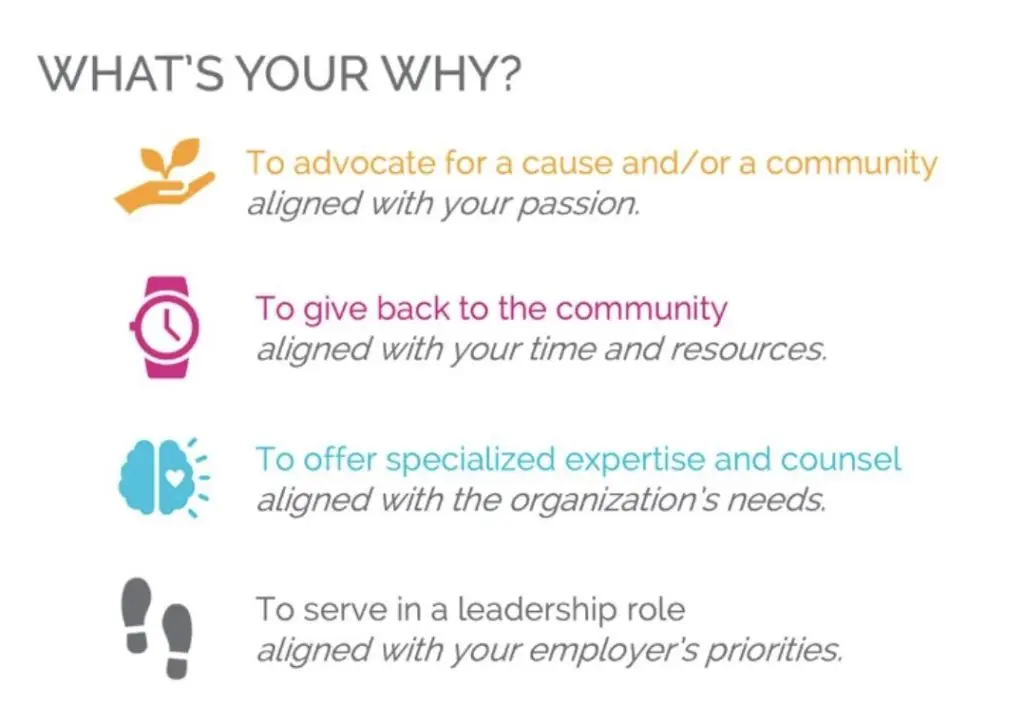
Once these why questions narrow down the options and opportunities, then we suggest that you find out more about the nonprofits still on your list:
1. Experience the mission by meeting with leaders, volunteering, attending a program, and reading their annual report, website, or social media.
2. Understand the business model by assessing the economic engine, impact engine, and debt. For example, if the organization generates most of its revenue from fundraising, that is a very different board experience than if it generates most revenue from earned income.
3. Clarify expectations to be certain that the time commitment, financial commitment, fundraising demands, and overall financial health of the organization are known.
When you are ready to join a board, here’s what to do — and not do — next:
DO
- Ask for a mentor and a formal onboarding to get fully oriented to the organization.
- Review basic governance documents, financials, and data dashboards to best understand the nonprofit’s current state.
- Prepare for meetings by reading materials in advance and asking questions.
- Show up at programs and events; nonprofit staffs work hard, and they notice when board members participate.
- Join a committee and begin engaging in the life and health of the organization.
- Make a commitment by contributing financially right away. It’s frustrating for development directors to have to chase board members down all fiscal year.
DON’T
- Make assumptions, as your experience on a previous board may or may not be relevant at this one.
- Overcommit by saying yes to too much or joining multiple boards at the same time. We recommend no more than two boards at a time.
- Consider your time as equivalent to a financial contribution, or your employer’s gift as a replacement for your support. They’re not the same.
- Ignore the power dynamics that may be impacting how the board governs and organization operates.
- Shy away from asking good questions. If board members remain quiet when they truly want to ask a question or disagree, they often hinder progress, because a candid conversation may be exactly what’s needed.
- Hide conflicts of interest, as they are not always problematic. It’s often the lack of disclosure that creates more issues.
Engaged board members are essential for nonprofits to thrive. When nonprofits are healthy, so too are the families and communities their mission is dedicated to serving.
We welcome your questions and additions to our do’s and don’ts!